
AIGC Digital New Retail Curriculum Development and Teaching & Research Training
Upgrading the Digital Business Talent Development System at the Fashion Textile College
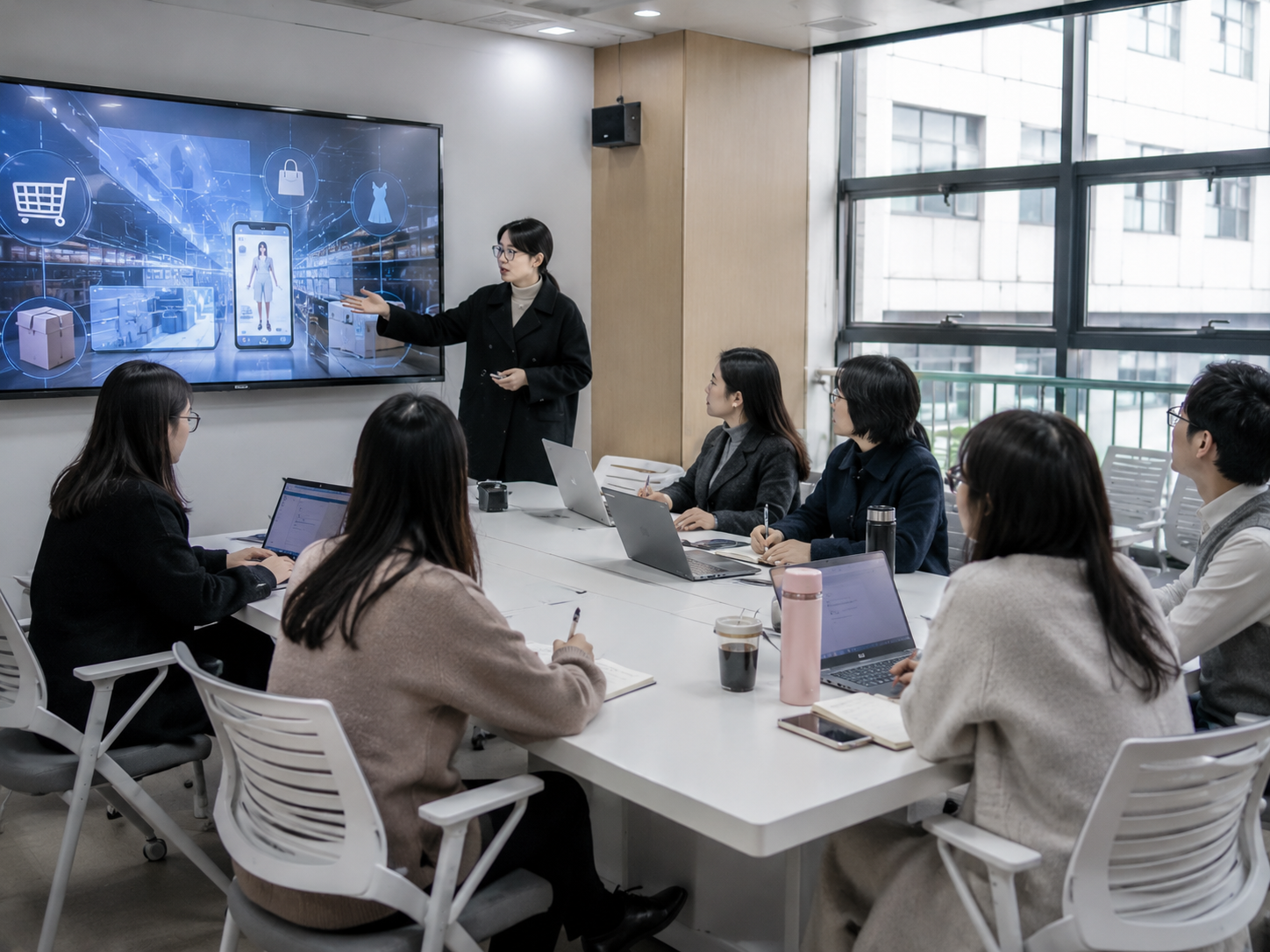
The battlefield of new retail is undergoing a quiet yet profound restructuring. As the traffic dividend of livestreaming rooms gradually fades, as homogeneous competition in short video content grows increasingly fierce, and as consumer attention becomes ever scarcer and more discerning, the industry’s competitive focus has shifted from “who can go live” to “who can use data to drive every operational decision,” and from “who can edit videos” to “who can build a complete capability loop from content creation to advertising optimization to business review.” The rapid maturation of AIGC tools has further accelerated this shift—they have dramatically lowered the technical threshold of content production while pushing the decisive point of competition toward higher-dimensional strategic capability and data literacy.
This industrial reality sets clear requirements for vocational education: talent cultivation in programs such as e-commerce, marketing, and new media operations can no longer remain at the level of training single skills; instead, it must build a composite competency system covering the full chain of “content creation—livestream operations—data insights.”
The college’s curriculum development project is precisely a systematic response to the requirements above. With a data insights platform and a data intelligence experimental practicum platform as its technology foundation, and with three hands-on courses—livestream e-commerce operations, short video creation and operations, and omnichannel data insights analysis—as its teaching core, the project has built a complete AIGC digital new retail curriculum system. The design logic, construction path, and course content of this system offer direct reference value for the digital business talent cultivation of similar institutions.
Problem Diagnosis: Three Fault Lines
Before designing the solution, the project team conducted an in-depth survey and analysis of the current teaching status of the college’s e-commerce and related programs. The findings revealed three structural fault lines in the current teaching system. These fault lines are not problems unique to the college, but common dilemmas faced broadly by digital business programs in today’s higher vocational colleges.
The first fault line lies between course content and industry practice.
Livestream e-commerce and short video operations are practical fields highly dependent on platform ecosystems. The recommendation algorithm logic of Douyin, the advertising strategy system of Ocean Engine Qianchuan, and the content review rules and traffic allocation mechanisms of various platforms—these core knowledge areas that form the foundation of practitioners’ daily work are severely absent from traditional textbooks and curricula. Teachers teach from textbooks written two or three years ago, and the “knowledge” students acquire is already outdated the moment they leave school. A deeper problem is that most courses still adopt a one-way teaching model of “first explaining theory, then reviewing cases,” leaving students without the complete practicum experience of planning, executing, and reviewing within real platform environments. A student who has never independently completed the full workflow of a livestream session, or never made a single advertising optimization decision based on real data, will find it difficult to quickly meet job requirements after employment.
The second fault line lies between single-skill training and full-chain capability building.
The operational logic of digital new retail is highly systematic. Behind a successful livestream is the seamless coordination of account positioning, product selection planning, script preparation, scene setup, going-live execution, traffic injection support, data monitoring, and review and optimization. Behind a high-conversion short video is the complete workflow of topic insight, script design, shooting execution, editing and packaging, publishing strategy, data analysis, and iterative optimization. However, existing curricula tend to break these steps into isolated teaching modules—one course teaches shooting and editing, another teaches marketing planning, and yet another teaches data analysis—so that students may master individual skills in each module but never build the full-chain mindset and collaborative operational capability from planning to execution to review. What the industry needs are “captains” who can coordinate the whole picture, yet the teaching system mostly produces “station workers” who can only execute a single step.
The third fault line lies between experience-driven and data-driven approaches.
Traditional e-commerce operations teaching often takes case analysis and experience summary as its main methodology—“how was a certain blockbuster case done” and “what are the characteristics of a certain top streamer’s script.” This experience-driven teaching approach was indeed effective in the early days of the industry, but it has become inadequate in today’s highly data-driven operating environment. Platform traffic allocation mechanisms increasingly rely on algorithmic recommendation, advertising optimization has been refined to the level of individual creatives and time slots, and the ability to collect and analyze user behavior data directly determines the quality of operational decisions. E-commerce operations talent lacking data thinking and data tool skills will face a systematic competitive disadvantage in the current industry environment. Moreover, in most e-commerce program curricula, the data analysis module is either missing entirely or replaced by generic Excel operations or a brief introduction to statistics, falling far short of the capability level the industry actually requires.
Together, these three fault lines constitute the core problems this project needs to solve. The design logic of the curriculum development plan is organized precisely around bridging these three fault lines.
Technology Foundation: Two Platforms Building the Practicum Infrastructure
Before building course content, it is first necessary to resolve the infrastructure question of “in what environment to teach and with what tools to practice.” The project deployed two core platforms for the college, which respectively serve the two major functions of data analysis practicum and AI experimental teaching.
The data insights platform is an enterprise-grade, one-stop data visualization and analysis system that provides unified tool support for all teaching segments in the curriculum involving data processing and business analysis.
The platform’s value is first reflected in the breadth of its data connectivity. It supports the connection of more than 40 types of data sources—from traditional databases such as MySQL and PostgreSQL, to real-time business data from e-commerce platforms such as Ocean Engine, Qianchuan, and Douyin short video, to operational documents in collaboration tools such as Feishu Sheets. This means that what students process in practicum is not practice datasets divorced from business context, but an analysis environment that can directly connect to real platform data flows. When students use real Qianchuan advertising data for ROI analysis in class, or real Douyin content data for view count prediction, they gain not only tool operation skills but also a deep understanding of the business logic behind the data.
The platform offers a rich array of chart types and interactive analysis capabilities for visual analysis. From basic bar charts, line charts, and pie charts, to Sankey diagrams for traffic path analysis, waterfall charts for performance composition analysis, and word clouds for category distribution analysis, to pivot tables and cross-tabs supporting multi-dimensional cross-analysis—these tools cover the vast majority of data analysis scenarios in digital new retail operations. The chart functions of drill-down, linking, filtering, and jumping enable students to explore layer by layer from macro trends to micro details within a single dashboard, building hands-on capability in data-driven decision-making.
The platform’s dashboard design capabilities are equally noteworthy. Flexible switching between free mode and tile mode, refined layout through layer management and widget composition, and visual customization through multiple system themes and custom themes—these features enable students not only to complete data analysis but also to package analysis results into professional visual reports, directly producing data products usable in business presentations and operational decisions. This capability has extremely high practical value in real work, yet it is almost entirely absent from traditional curricula.
More critically, the platform has built-in visual modeling capabilities that support building data processing pipelines through drag-and-drop operations. Basic operators cover routine operations such as data cleaning, field configuration, merge operations, and missing value imputation; intelligent operators provide machine learning capabilities such as feature engineering and clustering and classification, as well as natural language processing capabilities such as keyword extraction. This means students can build a complete workflow from data cleaning to intelligent analysis without writing any code—for e-commerce and marketing students, this low-code data analysis path is far more efficient and realistic than requiring them to start by learning Python programming.
The data intelligence experimental practicum platform is a comprehensive AI teaching platform integrating teaching, experimentation, practicum, and assessment in one, providing experimental environments and teaching management support for the teaching segments in the curriculum that involve understanding AI technology and applying AIGC tools.
The platform adopts a containerized architecture that supports high-concurrency online experimental teaching. Its experimental resource packages cover a complete technology stack from AI fundamentals to deep learning, large model development, and agent applications. For the digital new retail curriculum system, the modules most closely related to teaching scenarios are the agent experiment module and the industry application experiment module. The former covers content such as prompt engineering, RAG knowledge augmentation, and multi-agent collaboration, directly supporting teaching segments such as AIGC-assisted content creation and intelligent customer service building; the latter provides industry application projects such as intelligent customer service and policy interpretation agents, helping students understand how AI technology is implemented in business scenarios.
The platform’s teaching management functions provide teachers with full-process digital tools from course organization, experiment publishing, and progress monitoring to assessment and evaluation. Teachers can independently create course chapters and arrange experiments and courseware by drag-and-drop, can view students’ experiment progress and code submission records in real time, and can organize online examinations based on diversified question types (objective questions, short-answer questions, hands-on coding questions, and programming tasks based on Jupyter Notebook) with automatic generation of grade analysis reports. The value of this management toolset lies in freeing teachers from tedious teaching administration, allowing them to devote more energy to designing teaching content and providing personalized guidance to students.
The coordinated deployment of the two platforms builds a complete technology foundation for the operation of the entire curriculum system. The data insights platform carries the practicum needs of data analysis and business intelligence, while the data intelligence experimental practicum platform carries the practicum needs of AI technology learning and AIGC application; the former focuses on cultivating the ability to “make decisions with data,” while the latter focuses on cultivating the ability to “use AI for creation and automation.” Together, they support the cultivation goal of the digital new retail curriculum system for the competency structure of composite talent.
Curriculum System: Three Courses Building a Full-Chain Capability Loop
On top of the technology foundation of the two platforms, the project built three hands-on courses for the college that are closely connected and each with its own focus. The three courses are not three independent teaching units but an organic whole—together they cover the complete capability chain of digital new retail, from content creation and livestream operations to data-driven decision-making.
Livestream E-commerce Operations Course: From “Able to Go Live” to “Skilled at Operations”
The livestream e-commerce operations course spans 64 class hours and fully covers the capability development needs of the entire livestream e-commerce chain.
The starting point of the course design is not “how to use livestream tools” but “how to understand the business logic of livestream e-commerce.” The opening chapters guide students to systematically sort out the core concepts, platform characteristics, and business models of livestream e-commerce, establishing an overall cognitive framework for this business form. This seemingly basic content design is in fact deeply considered—many students’ understanding of livestream e-commerce remains at the superficial level of “streamers selling goods,” lacking a systematic understanding of traffic acquisition mechanisms, user conversion paths, supply chain coordination, and financial models. Without this cognitive foundation, all subsequent skill training would degenerate into fragmented imitation of operations rather than disciplined operational practice.
After the cognitive framework is established, the course unfolds progressively along the logical mainline of “team formation—account planning—product selection—script preparation—scene setup—live operations—data review—compliant operations.” Each teaching segment is paired with complete practicum tasks that require students to produce deliverable work outcomes in a project-driven manner.
Taking product selection as an example, students not only need to understand the basic principles and methodology of product selection, but also need to use the course’s product selection template to complete a full product selection plan for a specific category and target user group, with data-backed selection rationale. The livestream script preparation segment requires students to use a standardized script template to complete the full talking-point design of a livestream session, covering all stages including opening warm-up, product explanation, interaction guidance, closing-sales conversion, and ending previews. The data review segment requires students to complete a full review report from traffic analysis and conversion analysis to user profile analysis, based on real or simulated livestream data, and to propose optimization suggestions for the next session based on it.
A design element of particular note in this course is the deep integration of the AIGC intelligent assistant. The assistant supports functions such as script generation, livestream talking-point optimization, and product selection suggestions, which students can invoke at any time during practicum. This design is not meant to lower the learning difficulty, but to let students master the working mode of “human-machine collaboration” in actual practice—in current industry practice, efficient livestream operators are not those who reject AI tools, but those who are adept at using AI tools to improve work efficiency while injecting human judgment and creative value on top. By repeatedly experiencing the collaborative workflow of “AI generating the first draft—human review and revision—effect verification and iteration,” the course cultivates the core working methods students need to engage in livestream operations in the AI era.
The course also includes a dedicated compliant operations module that systematically explains regulatory requirements, platform rules, and key risk prevention points in the livestream e-commerce field. Against the backdrop of continuously tightening industry regulation, compliant operations capability has shifted from a “bonus item” to a “survival lifeline.” The inclusion of this module reflects the foresight and sense of responsibility in the course design.
Short Video Creation and Operations Course: From “Can Edit” to “Understands Operations”
The short video creation and operations course likewise spans 64 class hours, fully covering capability development across the entire short video creation process.
Unlike the many short video courses on the market that focus heavily on shooting and editing techniques, this course positions short video from the very beginning as “a commercial content product requiring systematic operations,” rather than merely “a creative work requiring technical mastery.” This difference in positioning directly shapes the course’s content organization and the focus of its capability development.
The front-end modules of the course focus on capability building at the strategy level. The account positioning segment requires students to complete the full planning process from target user analysis and content direction determination to differentiated value proposition design; the content planning segment trains students to master the methodology of topic insight, including practical skills such as trend tracking, user demand mining, and competitor content analysis; and the team formation and division segment helps students understand the responsibility boundaries and collaboration mechanisms of roles such as director, photographer, editor, and operator in short video projects. These “invisible” strategic capabilities are precisely what determine whether a short video account can continuously produce quality content and achieve commercial monetization.
The middle modules of the course cover the core technical skills of shooting and editing, but always place technical training within the framework of “serving the content strategy.” Script design is not an isolated creative writing exercise, but a structured design based on the account positioning and content direction determined in the front-end planning stage; shooting execution is not isolated camera technique training, but purposeful material acquisition driven by script requirements; and editing and packaging are not isolated software operation practice, but a systematic project of turning raw footage into finished content that conforms to platform recommendation logic and user viewing habits.
The back-end modules of the course focus on publishing strategy and data-driven operational optimization. The publishing segment trains students to master key operations that affect the initial recommended traffic of content, such as title writing, tag setting, publishing time selection, and first-round interaction guidance; the data analysis segment requires students to evaluate content effectiveness and diagnose problems based on real platform data (core metrics such as view count, completion rate, interaction rate, and conversion rate); and the iterative optimization segment guides students to formulate improvement plans for the next round of content based on data analysis conclusions, forming a continuous iteration loop of “creation—publishing—analysis—optimization.”
Just as in the livestream e-commerce course, the AIGC intelligent assistant is deeply integrated into the short video course. The assistant supports functions such as script generation, talking-point optimization, and topic suggestions, helping students efficiently complete the initial conception of content creation during practicum. The course guides students to treat AI-generated content as “raw material that needs to be screened, revised, and elevated by professional judgment,” rather than “finished products that can be used directly.” This teaching orientation effectively prevents students from over-relying on AI tools and cultivates their professional ability to create high-quality content with AI assistance.
Omnichannel Data Insights Course: From “Reading Data” to “Deciding with Data”
The omnichannel data insights course, with a concise 32 class hours, focuses on the systematic cultivation of data-driven decision-making capability.
This course plays the role of the “foundational capability provider” in the entire system. Whether it is traffic analysis and advertising optimization in livestream e-commerce, or content effectiveness evaluation and strategy iteration in short video operations, the core methodology points to the same capability origin: the ability to extract useful information from data, discover business patterns, and generate executable decision recommendations. The omnichannel data insights course provides systematic method training and hands-on tool practice precisely for the cultivation of this core capability.
The course takes “omnichannel data” as its core conceptual framework, guiding students to understand the diversity of data sources and the complexity of data types in the digital new retail environment. Transaction data from e-commerce platforms, interaction data from social media, effectiveness data from advertising campaigns, path data of user behavior, and POS data from offline stores—these data fragments scattered across different systems and platforms can only be transformed into insights of business value through effective collection, cleaning, integration, and analysis. The course unfolds along the complete chain of “data collection—data cleaning—data modeling—statistical analysis—indicator system design—visual presentation—business decision output.”
In the practicum stage, students operate directly on the data insights platform. Starting from data source connection and data synchronization configuration, they go through the standardized processes of data cleaning and quality assessment, learn the design methods of indicator systems and the definition norms of business meanings, master the selection principles of visual charts and the design methods of dashboards, and finally complete a full data analysis report oriented toward a specific business scenario.
The datasets provided with the course cover real business data from multiple industries, including consumer goods, e-commerce, and local life services, ensuring that what students practice on is not “teaching data” divorced from business context but “industry data” with real business meaning and analytical value. Each practicum project comes with standardized data cleaning sample sheets, indicator design tables, model templates, dashboard configuration templates, and business report templates, helping students establish a standardized data analysis workflow.
The application of the AIGC intelligent assistant in this course is equally noteworthy. The assistant supports functions such as data summary generation, first-draft report writing, indicator explanation, and visualization optimization suggestions. For students whose data analysis capabilities are still under construction, the intervention of the AI assistant can effectively reduce the difficulty of the cognitive leap “from data to insight,” enabling students to gradually build the ability and confidence for independent analysis while receiving necessary assistance.
Teaching Model: Project-Driven Three-Dimensional Integration
At the teaching method level, the three courses follow a unified design principle—the three-dimensional teaching model of “theoretical learning + platform practicum + enterprise cases.” The design of this model is not a simple patchwork of three teaching methods, but an organic integration based on the progressive logic of capability development.
The theoretical learning stage establishes the conceptual framework and methodological foundation. In this stage, students understand the “what” and the “why”—what the business model of livestream e-commerce is, what consumer psychology principles underlie product selection strategies, and what business meaning year-over-year and month-over-month calculations carry in data analysis. Theoretical learning does not pursue exhaustive knowledge coverage, but focuses on the core concepts and key methods directly related to the subsequent practicum.
The platform practicum stage turns theory into operational capability. In real platform environments, students complete the full operational process from planning to execution and produce deliverable work outcomes—a product selection plan, a livestream script, a data analysis dashboard, or a business insights report. The yardstick of the practicum stage is not “what exercises students did,” but “what outcomes students delivered.” This outcome-oriented practicum design directly benchmarks against the industry’s output requirements for practitioners.
The enterprise case stage provides industry perspective and practical wisdom as a supplement. The case library covers excellent practices from multiple mainstream platforms such as Douyin, Kuaishou, Xiaohongshu, and Taobao Live, helping students understand the differentiated operational logic of different platforms and the strategic thinking behind successful projects. Case analysis is not passive observation learning; it requires students to use the methodological framework learned in the theoretical stage to structurally deconstruct cases, and to propose their own optimization suggestions combined with the operational experience accumulated in the practicum stage.
The teaching activities of the three dimensions revolve around the same project task, forming a tight loop of “learn theory → practice on the platform → reflect and optimize against industry practice.” This loop is not one-off; it iterates repeatedly in every chapter of the course, enabling students to progressively deepen their understanding of knowledge and mastery of skills through continuous practice and reflection.
Teaching Resources and Services: A Complete Ecosystem Supporting Sustainable Course Operations
The long-term teaching quality of the courses depends not only on the design quality of the teaching content, but equally on the completeness of supporting resources and the sustained support of teaching services. The project carried out systematic planning and construction in both of these aspects.
Teacher-side resources cover all the needs of teaching preparation and teaching delivery. Syllabi and lesson plans provide the overall framework of the courses and the teaching design of each class; course PPTs and operation demonstration videos provide directly usable teaching materials for classroom instruction; task sheets and experiment guides provide standardized operational processes for organizing practicum segments; the question bank system supports online examinations with multiple question types and grade export, offering a convenient tool for assessment and evaluation; and the case library, datasets, and project templates provide a continuous supply of materials for enriching and updating teaching content.
What deserves particular emphasis is that the teacher-side resources are not a closed material package that “can only be copied and used as is,” but an open resource system supporting secondary development and custom extension. Teachers can adjust and supplement course content according to their own institution’s program characteristics and students’ actual levels, adding custom practicum tasks and assessment projects. This open design fully respects teachers’ teaching autonomy and provides the necessary flexibility for localizing the courses in different institutional environments.
Student-side resources are designed on the principle of “lowering the learning threshold and improving learning efficiency.” Step-by-step operation manuals and task guide pages ensure that students can complete practicum operations with minimal guidance; standardized work templates (account planning sheets, script design sheets, product information sheets, data analysis sheets, and so on) help students build standardized work habits; and the AIGC intelligent assistant provides immediate support at each practicum segment, lowering the entry difficulty of content creation and data analysis.
The teaching service system provides institutionalized assurance for the sustainable operation of the courses. Online teacher training ensures that instructors fully master platform operations and course teaching methods before classes begin; technical support and version upgrade services ensure the stability and timeliness of platform functions; and multi-dimensional teaching statistics reports (learning duration, project completion rate, assessment scores, and so on) provide a data basis for monitoring teaching quality and iteratively optimizing course content.
Extended Discussion on Several Design Philosophies
Beyond the technical solutions and course content, several layers of design philosophy in the construction process of this project are worth elaborating further.
On the necessity of “full-chain” cultivation. A common talent supply-demand mismatch in the industry is that companies hire “operators who can independently take charge of a project,” while schools cultivate “operators who can execute one step.” The root of this mismatch lies in the fragmentation of the curriculum—each course operates independently, and the individual skills students learn in each course cannot automatically integrate into a systematic capability oriented toward the complete business process. This project designs the three courses—livestream e-commerce, short video creation, and data insights—as an organic whole, with clear capability progression and content alignment among them, jointly serving the unified goal of “cultivating digital business talent with full-chain operational capability.” This kind of systematic curriculum design can improve talent development outcomes at a more fundamental level than improving the quality of any single course.
On the role of AIGC tools in teaching. The introduction of AIGC tools is a distinctive feature of this curriculum system, but it must be made clear that AIGC is positioned in the curriculum as a “capability enhancer,” not a “capability substitute.” The courses do not teach students how to let AI do the work, but how to complete work more efficiently and at higher quality with the assistance of AI. Students need to learn to judge the quality of AI-generated content, to inject professional judgment and creative value on top of AI output, and to understand the capability boundaries and applicable scenarios of AI tools. This ability to “harnes AI” rather than “depend on AI” is the true core competitiveness of students in the AI era. The courses emphasize the necessity of human review, revision, and optimization in every AIGC application segment, which is precisely the concrete implementation of this teaching philosophy.
On the weight of data capability in digital business education. In traditional e-commerce and marketing program teaching, data analysis is often regarded as a supplementary tool course, with a teaching weight far below that of “main” courses such as marketing planning and content creation. However, in today’s highly data-driven business environment, this weight allocation is no longer reasonable. Data capability is not a garnish-like add-on skill, but a foundational capability running through the entire process of content creation, livestream operations, and business decision-making. A livestream operator who cannot make product selection decisions based on data, a short video creator who cannot diagnose content effectiveness through data analysis, and a marketing planner who cannot speak with data will all face increasingly severe career bottlenecks in the current industry environment. This project lists the omnichannel data insights course as one of the three core courses alongside livestream e-commerce and short video creation, and provides unified tool support for the data analysis segments of all courses through the data insights platform—this is precisely a clear confirmation of the position data capability should hold in digital business education.
On the iterability of the curriculum system. Digital new retail is a field that changes extremely quickly. Platform rules are being adjusted, user behaviors are evolving, and new tools and playbooks keep emerging. If a curriculum system lacks the ability to iterate quickly, the timeliness of its teaching content will decline significantly within one to two years. This project reserves ample mechanism guarantees at the design level for the continuous updating of the courses: the secondary development capability on the teacher side ensures that teaching content can be adjusted in a timely manner as the industry changes; the platform’s version upgrade service ensures that technical tools always keep up with the latest product features; the continuous enrichment of the case library ensures that teaching materials will not become fixed and outdated; and the feedback mechanism of teaching statistics ensures that course improvement has a basis in evidence. The vitality of a curriculum system lies not in how perfect it is at delivery, but in whether it can continue to evolve after delivery.
From a Set of Courses to a Cultivation Paradigm
Stepping back from the project itself, the significance of this project at the college has gone beyond the building of several courses and the deployment of several platforms. It has in fact explored and validated a new talent cultivation paradigm for the digital business field.
The core characteristics of this paradigm can be summarized in four keywords: full-chain, data-driven, AI-enhanced, and project-output.
Full-chain means that the design of the curriculum system covers the complete business loop from content creation to operations execution to data decision-making, cultivating composite talent who can understand and drive the entire business process, rather than tool-oriented talent who can only handle a single step.
Data-driven means that data analysis capability is elevated to a core competency as important as content creation and operations management, and students need to support their decisions with data at every business step, rather than relying on experience and intuition.
AI-enhanced means that AIGC tools are systematically integrated into the entire teaching and practicum process, and students establish the work habits and methodology of collaborating with AI during their school years, preparing themselves for efficient output after entering the industry.
Project-output means that students’ learning outcomes are not exam scores or experiment reports, but a deliverable product selection plan, a complete record of a livestream execution, a professional data analysis dashboard, and an insightful business analysis report—these outcomes themselves constitute the most convincing proof of capability when students seek employment.
When the college’s students enter the job market with these capabilities and portfolios, what they demonstrate is not merely the experience label of “I have taken a livestream e-commerce course,” but the demonstrated capability of “I can independently complete the planning, execution, and review of a digital new retail project.” At a time when employers increasingly value actual output capability over academic credentials, this demonstrated capability is becoming the most substantial asset in career competition.
