
Building an AI Trainer Practicum Platform
Building an AI Practicum Hub at Guangdong Industry & Commerce Polytechnic
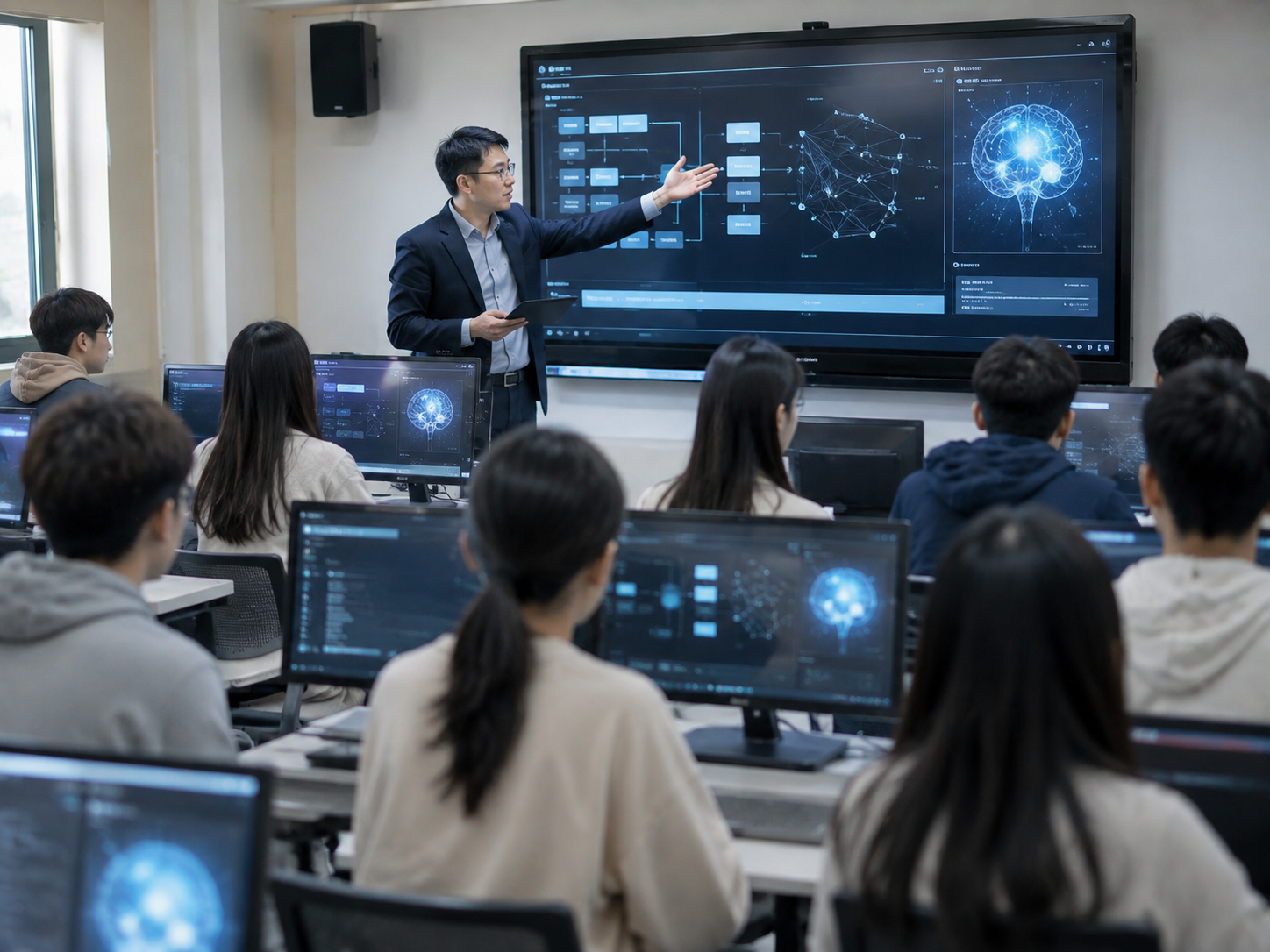
AI trainer, a new profession that has emerged alongside the intelligent transformation of industries, is becoming the key role connecting AI technology with industry application. In 2020, the Ministry of Human Resources and Social Security formally included “AI trainer” in the national occupational classification catalog. Since then, from visual quality inspection labeling in manufacturing to intelligent customer service optimization in the culture and tourism industry, from remote sensing image processing in surveying and mapping to data analysis and modeling in business operations, the demand for AI trainers across industries has continued to grow. However, in stark contrast to this robust market demand, systematic AI trainer development systems in higher vocational colleges remain at an early stage of exploration, and specialized practicum platforms capable of supporting the competency requirements of this role are severely lacking.
The AI trainer practicum platform project of Guangdong Industry & Commerce Polytechnic is a direct response to this gap. As an outstanding institution in the first round of the national “Double High Plan” (High-Level Vocational Colleges and Majors Construction Plan), the polytechnic has built an AI practicum hub that covers AI general education for more than 21,000 students across the school and provides scenario-based practicum services for six major program directions. The value of this project lies not only in the delivery of hardware facilities, but more importantly in the complete practicum teaching system constructed around the competency model of the AI trainer role, offering peer institutions a clear and replicable construction path.
The AI Trainer: An Underrated Key Role
Before discussing the construction of the practicum platform, it is necessary to first clarify a conceptual question: what exactly does an AI trainer do, why is this role so important, and why is the existing education system unable to effectively cultivate such talent?
The core responsibility of an AI trainer is to make AI systems genuinely “usable” in specific industry scenarios. For a general-purpose large language model or vision algorithm to move from the laboratory to industrial deployment, it must go through a series of refined engineering stages, including data collection and cleaning, annotation system design, model training and tuning, effect evaluation and iteration, and embedding business rules. It is the AI trainer who completes these stages. In short, if algorithm engineers are the “architects” of AI systems, then AI trainers are the “debuggers” and “operators” who get these systems running in real business.
The competency requirements of this role have a distinctly composite character. An AI trainer needs to understand the basic principles of machine learning and deep learning and master the technical tools of data processing and model training; to have an in-depth understanding of the business processes, quality standards, and data characteristics of the industry served; and to possess the engineering mindset needed to evaluate AI system outputs, diagnose anomalies, and handle them. This triadic competency structure of “technology + industry + engineering” determines that the cultivation of AI trainers cannot follow a purely theoretical teaching route, nor rely on fragmented tool training, but must be accomplished through a systematic, scenario-based practicum teaching system.
However, higher vocational colleges currently face three common dilemmas in cultivating AI trainers.
First, the gap between practicum conditions and job requirements. The daily work of an AI trainer relies heavily on GPU computing resources and specialized data processing tools, yet most higher vocational colleges still configure their computer practicum labs primarily with general-purpose PCs, which cannot support core practicum stages such as deep learning model training, large-scale data annotation, and model deployment debugging. Students lack opportunities to engage with real AI engineering environments during their studies, and after graduation they often need a long adaptation period when facing enterprise production systems.
Second, the disconnect between course content and industry scenarios. Most existing AI-related courses are organized around general technical knowledge and lack deep binding to specific industry application scenarios. Students can reproduce the training flow of classic algorithms in a laboratory environment, but do not know how to apply the same technology to defect detection on an industrial production line or intelligent classification of a set of remote sensing images. The core value of an AI trainer lies precisely in “making AI fit the industry”; technical training detached from industry scenarios cannot cultivate this core capability.
Third, the contradiction between single-major cultivation models and composite job demands. The industries served by AI trainers are extremely diverse, yet higher vocational colleges typically organize their programs along disciplinary lines—computer science students do not understand surveying and mapping, surveying and mapping students cannot program, and business administration students can neither program nor understand algorithms. The interdisciplinary composite competencies required by AI trainers are difficult to cultivate systematically under existing disciplinary barriers.
The practicum platform construction of Guangdong Industry & Commerce Polytechnic is precisely a systematic attempt to solve the three dilemmas above.
Platform Architecture: A Three-Layer Integrated Practicum System Design
Based on the competency model of the AI trainer role and the characteristics of the polytechnic’s program structure, the project team designed a three-layer integrated practicum platform architecture: “general education layer—practicum layer—scenario layer.” The three layers are not a simple stacking of functions, but follow the progressive logic of “cognition foundation—skill construction—scenario transfer” in competency development, jointly serving the systematic cultivation of the core competencies of the AI trainer role.
The general education layer: an AI literacy foundation covering the entire school. The general education layer is open to all students across the school, providing learning and foundational practicum in AI basic cognition, large model application principles, and prompt engineering through a unified AI general education platform. The design intent of this layer is not to cultivate professional AI trainers, but to establish a basic framework for understanding AI technology for all students—under the trend of comprehensive industrial intelligence, even those who do not take up AI trainer roles need to understand the basic working methods, capability boundaries, and collaboration norms of AI systems as practitioners in any professional direction. The general education layer also carries out a screening function of “talent discovery”: students who demonstrate strong interest and potential during the general education stage can further enter the deep cultivation channels of the practicum layer and scenario layer.
The practicum layer: the computing and platform foundation supporting core skill training. Centered on 40 AI computing workstations and a unified practicum management platform, the practicum layer provides GPU computing resources and engineering-oriented operating environments for technical practicum in deep learning model training, computer vision algorithm development, and large model inference and fine-tuning for the AI technology application program and the backbone classes of each college. The practicum management platform integrates functions such as computing resource scheduling, one-click deployment of experimental environments, course management, and collection and analysis of student learning data. This layer directly corresponds to the technical competency requirements of the AI trainer role—core workflows such as data preprocessing, model training and tuning, and effect evaluation and iteration all require repeated practice in a real computing environment to develop solid hands-on skills. Without sufficient computing support, practicum teaching for AI trainers would be like clinical medical teaching without an operating room, where all operations can only remain paper-based reasoning.
The scenario layer: cross-major, industry-grade case practicum. The scenario layer is the most differentiated design component of the entire platform and the key link directly serving the cultivation of AI trainers’ “industry adaptation capability.” Around the polytechnic’s program directions in surveying and mapping, intelligent manufacturing, automotive, industry and commerce, and commerce and arts, the project team developed an industry-grade cross-major scenario case library. Each case is set against a real business scenario of a specific industry and requires students, in the role of AI trainers, to complete the full practicum loop from requirements analysis, data governance, and model training to deployment verification. The core design philosophy of this layer is that the professional value of an AI trainer lies not in how many general-purpose algorithms one has mastered, but in whether one can effectively transfer technical capabilities into specific industry scenarios to solve real business problems. The scenario case library of this layer provides a structured training vehicle for cultivating precisely this transfer capability.
The coordinated operation of the three layers forms a complete chain for cultivating AI trainer competencies: the general education layer builds cognitive foundations and professional identity, the practicum layer hones core technical skills, and the scenario layer realizes the transfer and integration of industry application capabilities. This architectural design ensures that the practicum platform is not a single-function collection of equipment, but a teaching infrastructure capable of systematically supporting the entire talent development process.
The Scenario Case Library: The Core Vehicle for Cultivating AI Trainer Competencies
The design and development of the cross-major scenario case library is the work package in this project that required the greatest effort, carries the highest technical content, and best demonstrates the value of platform construction. The project team abandoned the “grab-and-use” approach of generic AI teaching cases, instead going deep into the core business processes of each aligned program cluster to precisely identify the key entry points where AI trainer competencies can generate real value, and developing complete teaching cases around these entry points.
The AI + surveying and mapping scenario is the most industry-distinctive component of the case library. The case content covers core business scenarios such as AI-based intelligent recognition and ground feature classification of remote sensing imagery, intelligent segmentation and 3D reconstruction of airborne LiDAR point cloud data, and AI-assisted automatic extraction of geographic information elements. In practicum, students need to complete the full workflow from quality assessment and preprocessing of remote sensing data, design and execution of annotation systems, selection, training, and accuracy verification of classification models, to manual review and quality control of intelligent extraction results. These stages correspond precisely to the typical work content of AI trainers in the surveying and mapping industry. As the intelligent transformation accelerates in fields such as natural resource surveys, territorial spatial planning, and infrastructure monitoring, surveying and mapping technical talent with AI data processing capabilities is becoming a scarce resource urgently needed by the industry, and the case development in this direction carries clear industry-oriented significance.
The AI + intelligent manufacturing scenario focuses on two technical fields with the most promising prospects for large-scale application in manufacturing: machine vision defect detection and industrial AI quality inspection. The cases require students to complete a full closed-loop practicum, including designing image acquisition schemes for industrial products, formulating annotation specifications for defective samples, training and tuning vision detection models, and quantitatively evaluating detection accuracy and miss rate. The case design particularly emphasizes the special requirements industrial scenarios impose on AI trainers—unlike internet applications, industrial AI imposes extremely strict engineering constraints on model accuracy, inference latency, robustness, and false alarm control. Students must understand and internalize these constraints during practicum in order to meet manufacturing customers’ quality expectations of AI systems in their future roles.
The AI + automotive scenario targets the intelligent connected vehicle industry, focusing on data annotation and model training for on-board perception algorithms. As intelligent driving technology moves from the laboratory to mass production, the demand for AI trainers capable of participating in autonomous driving dataset construction, perception model annotation quality management, and vision recognition algorithm testing and verification is growing rapidly. The case development in this direction provides students with practicum opportunities to engage with cutting-edge technology application scenarios.
The AI + industry and commerce scenario serves business programs, with cases focusing on the application of AI data analysis in business decision-making, dialogue flow design and effectiveness optimization of intelligent customer service systems, and the construction and debugging of financial agents. For students with a business background, the role of AI trainer is more oriented toward business-side requirements definition, data governance, and effectiveness evaluation, rather than the development of underlying algorithms. The case design accurately captures this role division, guiding students to understand the working methods and value-creation approaches of AI trainers within a business context.
The AI + arts and creativity scenario revolves around the application of AIGC technology in cultural creative product design and multimodal content generation. Cases in this direction focus on typical AI trainer tasks such as style-based fine-tuning of generative AI models, optimization of prompt strategies, and quality evaluation and selection of generated content, helping art program students master professional methods for harnessing AI generation tools in the creative industry.
The construction of the entire case library follows unified design specifications. Each case includes complete teaching elements such as business background analysis, dataset preparation and quality documentation, technical solution design guidance, model training and tuning operation guides, and result evaluation standards and analysis methods. The design goal of the cases is not to let students “get a demo running,” but to let them fully experience, in a practicum environment simulating real working conditions, the entire process of an AI trainer from “receiving a requirement” to “delivering results,” building the abilities of problem analysis, solution design, and quality control oriented toward specific industry scenarios.
Curriculum Integration: Embedded Transformation Rather Than Starting from Scratch
The teaching value of the scenario case library is ultimately realized through organic integration with the polytechnic’s existing curriculum system. At the curriculum development level, the project adopted an “embedded transformation” strategy—implanting practicum modules related to AI trainer job competencies into existing core courses, rather than independently launching an entirely new curriculum system.
This strategic choice is based on a sober assessment of the teaching management realities of higher vocational colleges. For an institution that has been operating for many years with relatively fixed training programs and credit-hour allocation, large-scale curriculum restructuring faces practical obstacles such as lengthy approval processes, difficult faculty reallocation, and disputes over encroaching on credit hours. A more efficient and feasible path is to identify, within each core course, teaching segments that have natural points of alignment with AI trainer competency requirements, embed carefully designed practicum content in these segments, and achieve the greatest incremental gain in competency development at the smallest cost of curriculum adjustment.
At the concrete implementation level, the school-wide basic computer course embeds an AI general education module, enabling students to build a basic understanding of the AI trainer career direction during their general courses; the machine learning and deep learning courses are upgraded to a practicum teaching model based on GPU computing resources and industry-grade datasets, strengthening hands-on training of AI trainers’ core technical skills; the surveying and mapping data processing course adds practicum segments on AI image recognition and intelligent point cloud processing; and the industrial control and inspection course introduces machine vision AI quality inspection practicum. The embedded practicum content forms a complementary relationship with the professional knowledge of the original courses, so that while learning traditional professional skills, students naturally master the working methods and technical tools of AI trainers in that industry field.
The embedded transformation strategy also brings an important incidental benefit: it effectively reduces pressure on faculty. After receiving focused training, professional course teachers can carry out AI practicum teaching within the framework of courses they are already familiar with, rather than having to learn an entirely new AI course from scratch. This faculty development path of “making incremental extensions on top of existing capabilities” is far more realistic and sustainable than requiring teachers to completely transform into AI teachers.
Faculty Empowerment: Building Sustainable Teaching Operation Capability
The long-term value of the practicum platform ultimately depends on whether teachers can effectively integrate it into daily teaching practice and continuously iterate and optimize. The project designed a three-phase faculty empowerment program of “focused training—on-site support—long-term consultation,” with the core goal of completing the handover of teaching operation capability at the same time as project delivery.
The first phase is a 3-day focused training session that uses the specific courses teachers are about to take on as the vehicle, completing the full transfer of skills from platform operation and case teaching methods to analysis of student learning data. The yardstick of the training is not how much content teachers “listened to,” but whether teachers can independently complete the teaching preparation and delivery of a complete AI practicum course after the training ends.
The second phase is 30 days of on-site implementation support. The technical team works on campus to assist teachers in smoothly advancing the first round of teaching, while collecting frontline teaching feedback for targeted optimization of platform functions and case content.
The third phase is a 1-year remote technical consultation service, providing continuous professional support for the various technical and teaching problems teachers encounter in their daily teaching.
The design logic of this program is clear and pragmatic: in the short term, rely on the deep involvement of an external professional team to ensure teaching quality in the initial stage of platform launch; in the medium and long term, rely on the polytechnic’s own faculty to achieve endogenous growth of AI practicum teaching capability. What the project ultimately delivers is not just a set of equipment and a batch of course resources, but a faculty team capable of independently operating and continuously iterating AI trainer practicum teaching.
Deep Reflections on the Construction Logic
Beyond the technical solutions and product configurations, several layers of thinking in the construction process of this project deserve further discussion.
On the relationship between “practicum platform” and “teaching capability.” A common misconception is to equate practicum platform construction with equipment procurement and software deployment. This understanding causes project acceptance to become the peak of the platform’s lifecycle—equipment in place, software launched, acceptance passed—after which it gradually degenerates into a “showcase” facility with low utilization in subsequent teaching practice. The design philosophy of this project is that equipment and platforms are the vehicle, course cases are the content, and faculty capability is the engine. All three are indispensable, but what truly determines the platform’s long-term value are the latter two. Therefore, the effort and resources the project invested in case library development and faculty empowerment are at least of the same magnitude as the investment in hardware configuration.
On the balance between “dedicated” and “shared.” Should the AI trainer practicum platform be an exclusive facility for the AI program, or a shared infrastructure for the entire school? The answer of this project is the latter. The composite nature of the AI trainer role determines that cultivating talent only within the computer science program is far from sufficient—an AI trainer who does not understand surveying and mapping business cannot do good remote sensing image annotation, and an AI trainer who does not understand manufacturing processes cannot design effective defect detection solutions. The practicum platform must be open to all program directions, allowing AI technical capabilities and industry knowledge to collide and merge in the same practicum environment, in order to cultivate truly composite AI trainers who meet job requirements. This is the fundamental basis of the “school-wide sharing” design approach.
On the trade-off between “one-shot completeness” and “phased construction.” Under the realistic constraint of a limited budget, should resources be concentrated on building a small, refined special-purpose practicum lab, or should a modest investment be used to build a foundational platform with broader coverage? This project chose the latter—with a Phase 1 budget of 1.5 million yuan, simultaneously covering three layers: school-wide AI general education, core program practicum, and cross-major scenario cases. The logic behind this choice is that for AI trainer talent development, “breadth” and “depth” are equally important. High-end practicum facilities usable by only a small number of students cannot change the fundamental situation of missing AI literacy at the school level; conversely, a general education platform lacking deep practicum conditions cannot cultivate AI trainers with real job competencies. The three-layer integrated architecture balances both needs within a limited budget while reserving a clear upgrade path for Phase 2 expansion.
On the lifecycle management of the practicum platform. The iteration speed of AI technology far exceeds the update cycle of traditional practicum equipment. The GPUs configured today may no longer be sufficient to run mainstream models in three years, and the teaching cases developed today may no longer fit the latest technical frameworks in two years. The design of a practicum platform must be embedded with an “iterability” gene. The modular design at the architectural level, the standardized development specifications of the case library, and the continuous faculty empowerment mechanism in this project are all structural arrangements made for the platform’s long-term iteration capability. An excellent practicum platform is not a static deliverable, but a dynamic system capable of continuous growth in response to technological evolution and changes in industrial demand.
From Platform Construction to Talent Supply
Zooming out to a broader perspective, the AI trainer practicum platform construction of Guangdong Industry & Commerce Polytechnic has significance that transcends the category of teaching facility upgrades for a single institution.
From the industry demand side, the Guangdong-Hong Kong-Macao Greater Bay Area is in a critical period of intelligent transformation of manufacturing. Industrial clusters such as intelligent manufacturing, intelligent connected vehicles, smart cities, and digital creativity continue to release demand for AI trainers, yet talent supply is severely insufficient. As the main battleground for cultivating technical and skilled talent, higher vocational colleges have both the responsibility and the conditions to take on the task of large-scale AI trainer cultivation. The key is that such cultivation cannot be general technical training detached from the industrial context; it must be scenario-based practicum deeply bound to specific industries. This is precisely the industrial logic behind the cross-major scenario case library construction of this project.
From the education supply side, hundreds of engineering-oriented higher vocational colleges across the country face challenges similar to those of Guangdong Industry & Commerce Polytechnic—abundant existing practicum resources but missing AI capabilities, complete program categories but insufficient interdisciplinary integration, strong faculty teams but limited AI teaching experience. The construction model explored by this project—“three-layer integrated architecture + embedded curriculum transformation + scenario-based case-driven teaching + tiered faculty empowerment”—has high reference value and reproducibility in dimensions such as budget scale, implementation difficulty, and teaching effectiveness.
Once this practicum system runs stably, the polytechnic will be able to supply society every year with a cohort of graduates who combine AI technical capabilities with industry application experience. They may not become AI researchers who design algorithm architectures, but they will become AI trainers capable of completing intelligent classification of remote sensing imagery in surveying and mapping projects, AI trainers capable of deploying and maintaining vision quality inspection systems on manufacturing production lines, and AI trainers capable of building and optimizing intelligent data analysis workflows in business operations. These professionals, rooted in the front lines of industry and able to make AI technology genuinely create value in specific business scenarios, are precisely the most scarce and most urgently needed force in the current industrial intelligent transformation.
Cultivating such talent requires not only a practicum room full of GPUs, but more importantly a systematically designed talent development infrastructure capable of sustained operation and iteration. This is precisely the construction goal pursued by this project of Guangdong Industry & Commerce Polytechnic, and also the direction in which we continue to deepen our efforts in the field of AI trainer practicum platform construction.
