
AI Trainer Training by the School of Artificial Intelligence
A College-Wide AI Literacy Development Practice at Changsha Commerce and Tourism College
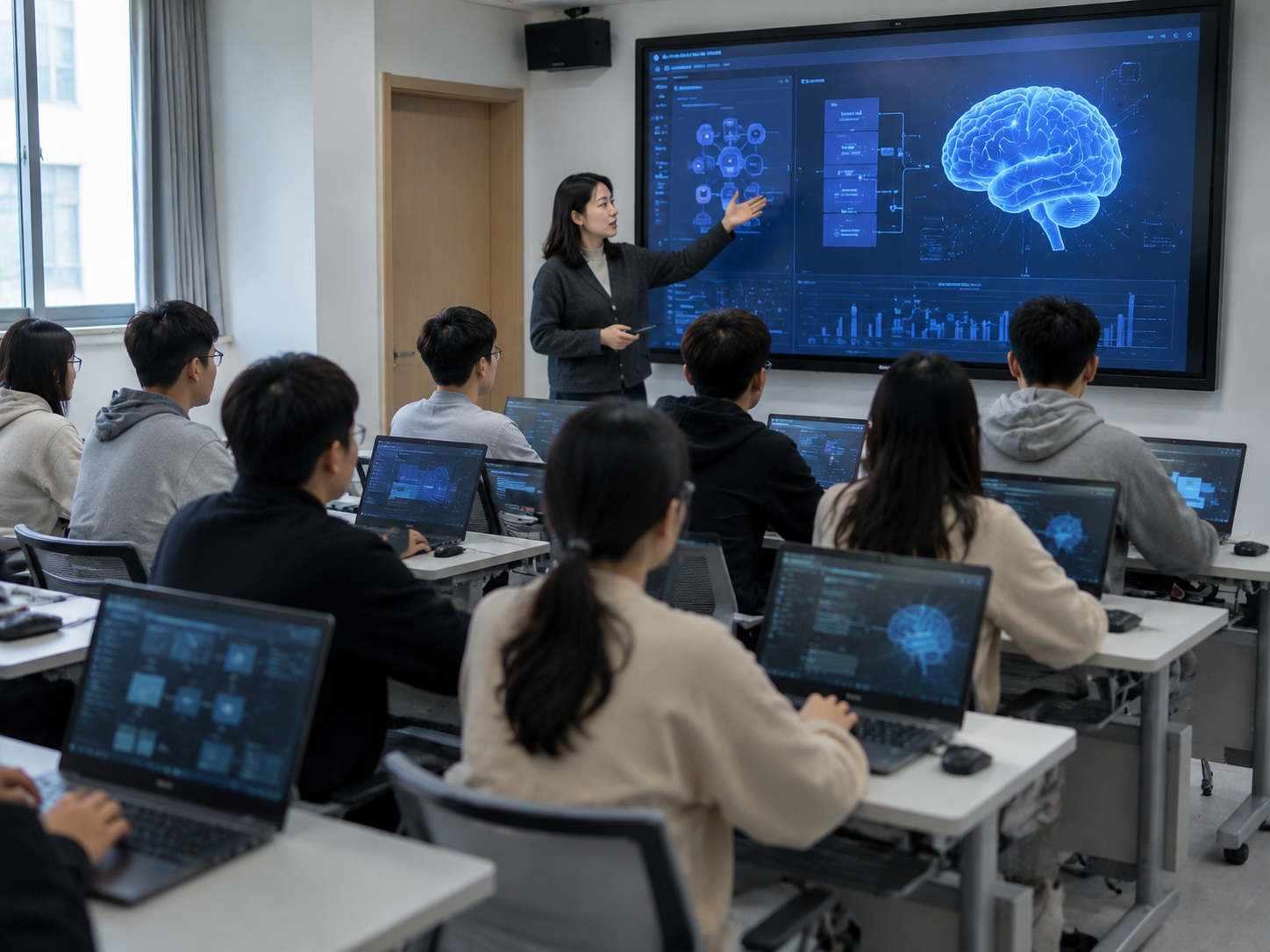
A direct question: when a vocational college decides to comprehensively promote AI-integrated teaching, what is the first obstacle that must be overcome?
It is not a lack of computing power, not a missing platform, not an absent curriculum — it is that teachers do not know how to use it.
More precisely, among the 800+ faculty and staff members, the vast majority's understanding of artificial intelligence remains at the level of fragmented information drawn from news headlines and social media. They have heard of DeepSeek and may have tried a text-generation tool once or twice, but they have never systematically considered the question: what is the actual relationship between AI and my daily work? Which parts of my classroom, my management, and my student affairs could be substantially transformed by the involvement of AI?
Unless this question is resolved, no matter how much funding the college invests in building AI laboratories, procuring more advanced training platforms, or developing more refined AI courses, it will ultimately face the same dilemma: the facilities are there, but no one truly knows how to use them, is willing to use them, or dares to use them.
The teacher training program organized by the School of Artificial Intelligence at Changsha Commerce and Tourism College directly confronts this most fundamental issue. With six groups of participants and six days of training, the goal is singular: to ensure that every faculty and staff member, upon leaving the training room, holds in hand an AI application plan that can be put into practice in the first week of the next semester.
The Real Starting Point: Three Thresholds
Before designing the training program, the project team conducted an in-depth baseline analysis of the faculty and staff's current AI awareness and application status. The findings were not surprising, yet their severity still deserves serious attention.
Faculty and staff generally face three thresholds in applying AI, which the project team summarized as the “three don'ts” — don't understand, don't know how to use, and don't dare to use.
“Don't understand” is a barrier at the cognitive level. A considerable proportion of faculty and staff still perceive AI through the lens of science-fiction narratives or media hype, lacking a systematic understanding of how AI fundamentally works, the real capability boundaries of current technology, and the specific pathways through which AI affects the education sector. This cognitive vacuum produces two equally harmful consequences: some people, because they do not understand AI, develop an instinctive rejection and fear, viewing AI as a force that threatens the existence of the teaching profession; others, for the same reason, hold unrealistic expectations, believing that AI can automatically solve every teaching challenge. Whether fear or superstition, neither is a healthy mindset for advancing AI-integrated teaching.
“Don't know how to use” is a barrier at the skills level. Even teachers who are open to AI often find themselves stuck when facing specific tool operations. Although DeepSeek's conversational interface is simple, how to craft a prompt that generates a high-quality draft lesson plan, how to judge the accuracy and suitability of AI-generated content, and how to embed AI tools into existing teaching workflows rather than simply “trying them out and putting them down” — these are practical operational issues that cannot be resolved by reading a WeChat article or attending a two-hour tool demonstration.
“Don't dare to use” is a barrier at the psychological and institutional level. Teachers' concerns about AI tools arise not only from unfamiliarity with the technology, but also from uncertainty about the boundaries of use: does a lesson plan generated by AI count as academic misconduct? Does feeding students' grade data into an AI analysis tool violate privacy protection regulations? Will guiding students to use AI in the classroom lead to over-reliance and a loss of independent thinking? If AI-generated content contains factual errors or ideological deviations, what responsibility do teachers bear? These concerns are not unfounded worries; they are real questions that every responsible teacher inevitably faces when deciding whether to bring AI into teaching practice. If the training cannot directly address these concerns and provide clear operational guidance, teachers will most likely choose the conservative path of “the less trouble, the better,” even after mastering tool skills.
The three thresholds are interlocked and progressive. Not understanding leads to not knowing how to use; not knowing how to use intensifies the reluctance to use; and the reluctance in turn reinforces the lack of understanding. To break this cycle requires not a broad, one-size-fits-all general lecture, but a systematic training program that precisely identifies the needs of different groups and tackles each threshold in a tiered and categorized manner.
Design Logic: Tiered and Categorized Training Tailored to Needs
The 800+ faculty and staff members have vastly different job responsibilities, and their needs for AI span an enormous range. A middle-level manager needs to understand the strategic impact of AI on discipline development and management decision-making; a full-time teacher in the Business School needs to master how AI data analysis tools can be integrated into marketing classrooms; a counselor needs to learn how to use AI tools to improve the efficiency of ideological and political education and psychological early warning; and a newly hired teacher needs a complete AI tool introduction covering lesson preparation, teaching, and grading. Putting people with such completely different needs in the same classroom to listen to the same lecture can only end in one way: managers find it too shallow, technical backbones find it too general, counselors find it irrelevant, and new teachers cannot keep up.
Based on this judgment, the project team divided the 800 participants into six training groups, each with its own training theme, course outline, hands-on content, and deliverable requirements.
College-wide training (550 people). Open to all faculty and staff, positioned as “cognitive enlightenment.” Its core mission is to help every participant build a basic understanding of AI, eliminate technological fear, experience mainstream tools first-hand, and clarify usage boundaries. This is the foundation of the entire training system — all subsequent categorized training is built on the shared cognitive consensus established by the college-wide training.
Middle-level management and high-caliber talent training (250 people). Open to all middle-level managers, teachers with associate professor or higher titles, PhD holders, and party branch secretaries, positioned as “strategic empowerment.” Its core mission is to help managers and academic leaders understand the direction of digital-intelligent transformation from the height of national policy and industry trends, and develop the decision-making capability to promote AI-integrated development at the departmental and disciplinary levels.
Elite backbone training (30 people). Open to teachers of the School of Artificial Intelligence and digital-intelligent teachers transferred from other majors, positioned as “practical breakthrough.” Its core mission is to systematically resolve the three major questions of “how to build the course, how to teach the class, and how to use the tools,” with training outcomes directly serving the AI general education teaching after the semester begins.
Full-time teacher thematic training (450 people). Open to all full-time teachers, positioned as “categorized and precise empowerment.” Its core mission is to provide grouped training across the four professional directions of the Business School, Tourism School, Software School, and School of Cultural Creativity, and to answer the question every teacher cares about most: “How exactly do I use AI in my specialized courses?”
Counselor thematic training (80 people). Open to deputy secretaries of secondary schools, student affairs officers, and all counselors, positioned as “empowerment for student education scenarios.” Its core mission is to focus on the four major scenarios of ideological and political education, affairs management, psychological support, and employment guidance, helping counselors master practical application paths for AI tools.
New teacher pre-service training (25 people). Open to all newly hired teachers, positioned as “building the foundation for a career launch.” Its core mission is to help new teachers develop basic AI tool skills from their very first day through small-class full-process hands-on practice, achieving “ready to use from day one.”
The six types of training are not isolated and parallel; they have clear logical progression and complementary functions. College-wide training establishes the consensus foundation, middle-level training ensures top-down strategic momentum, elite backbone training forges the core teaching team, full-time teacher training achieves full coverage at the front line of teaching, counselor training fills the application gaps in student education scenarios, and new teacher training ensures that new faculty possess AI literacy from the very beginning. Together, the six levels of training form a complete organizational capability-building system — from strategic awareness to tool operation, from teaching innovation to student management, from senior teachers to new employees, leaving no blind spots and no dead corners.
College-Wide Training: Cognitive Ice-Breaking for 550 People
College-wide training is the largest and most distinctive segment of the entire training system. The 550 faculty and staff members come from completely different backgrounds spanning engineering, business, tourism, arts, and administration, with AI foundations ranging from zero to some prior exposure, distributed highly unevenly. Within the time constraint of six class hours in a single day, the training must explain what AI is and how it works, enable every participant to operate the tools first-hand and develop real hands-on experience, and clarify usage norms and ethical boundaries — this places very high demands on the precision of course design and the control of pacing.
The training adopted a progressive structure of five modules: “cognition — principles — hands-on practice — norms — consensus.”
The first half of the morning focused on cognitive enlightenment. Rather than starting from technical jargon, the instructors began from a perspective every teacher could understand: how AI is changing “the way people do things.” The shift of humans from task executors to managers and decision-makers, and human-machine collaboration becoming a new working paradigm — these seemingly abstract statements were translated into intuitive, tangible understanding through concrete cases from the commerce, tourism, and education industries. The core goal of the opening was not to turn everyone into an AI expert, but to give everyone a basic judgment: AI is related to my work, and this relationship has already shifted from “might be relevant in the future” to “is relevant right now.”
The second half of the morning moved into general explanations of core technical principles. This is the segment that most tests the instructors' expertise in college-wide training — making administrative staff, physical education teachers, and counselors with no technical background understand the core ideas of machine learning and the basic workings of large models, while avoiding simplifying the content to the point of losing accuracy. The instructors used numerous daily-life analogies and visual demonstrations to convert concepts such as “the relationship between data and models,” “the logic of supervised learning,” and “how generative AI works” into knowledge that non-technical people can understand and remember. The design philosophy of this module is: teachers do not need to know the mathematical formulas of neural networks, but they do need to understand the basic logic by which AI “learns” an ability — because only by understanding this logic can teachers make correct judgments when using AI tools later: which tasks AI excels at, which tasks AI cannot handle, and why AI-generated results sometimes go wrong.
The hands-on session in the afternoon was the core experiential segment of college-wide training. 550 people operated online simultaneously, using DeepSeek to generate work notices and activity plans, using AI tools to automatically generate meeting minutes, using intelligent PPT tools to create courseware, and experiencing the AI-generated workflow for drafting lesson plans. Every operational task directly corresponded to high-frequency scenarios in the daily work of faculty and staff, ensuring that participants could clearly feel during the process: this tool really can save me time and improve quality. The design philosophy of the hands-on session was not “show how powerful AI is” but “let everyone verify with their own tasks that AI is genuinely useful.” When an administrative staff member who had never touched an AI tool personally generated a passable draft of a work notice in three minutes with DeepSeek, that intuitive feeling of “it really is this simple” broke down the psychological barrier of “AI is far away from me” more effectively than any theoretical explanation.
The norms and ethics module directly addressed the widespread “don't dare to use” concerns among the faculty. Rather than vaguely discussing “be mindful of ethics,” it provided specific, actionable behavioral guidelines: which data is strictly forbidden to enter AI systems, where the specific boundaries of AI use in teaching scenarios lie, how the copyright of AI-generated content is defined, and where the dividing line between academic integrity and AI assistance sits. These specific operational guidelines can genuinely eliminate teachers' usage concerns far more effectively than abstract ethical principles. Only when teachers clearly know “what can be done and what cannot be done” will they have the confidence to boldly explore within the range of what “can be done.”
The last half hour of college-wide training was the consensus-building segment. Groups discussed “what AI can do in my position,” and each participant wrote down a “small goal for smart tool application” that could be implemented in their own position. This seemingly simple action was actually the most critical deliverable of the entire college-wide training — it transformed six hours of learning experience into a concrete action commitment and provided clear learning motivation for the subsequent categorized training.
Middle-Level Training: From Tool Use to Strategic Decision-Making
If college-wide training addresses the problem of “individual cognition,” then middle-level management and high-caliber talent training addresses the problem of “organizational momentum.”
The digital-intelligent transformation of a school cannot be achieved through the spontaneous exploration of individual teachers alone. It requires management to possess clear strategic judgment, academic leaders to see the paths through which AI drives interdisciplinary integration, and departmental heads to have the ability to organize and promote digital-intelligent work within their own scope of responsibility. Without consensus and momentum at the strategic level, the AI application efforts of frontline teachers will remain at the level of sporadic individual attempts and will never coalesce into systematic organizational capability.
The 250-person middle-level training was clearly distinct from college-wide training in content design. The training no longer started from tool operation but from national strategy and policy interpretation. The core essence of the “AI + Education Action Plan” jointly issued by the Ministry of Education and four other departments, the goal of building an AI education system covering all stages of learning by 2030, and the policy framework of teacher intelligent literacy standards — this macro-level information is an indispensable cognitive foundation for managers who need to make departmental and disciplinary development decisions.
The discipline development and talent cultivation module explored in depth the specific paths through which AI drives interdisciplinary integration. Using AI as a catalyst to promote disciplinary crossover, the “concept AI → basic AI → advanced AI” tiered educational design framework, and the key content points of AI general education courses for commerce and tourism majors — these contents directly serve the needs of teachers with associate professor or higher titles and PhD holders in judging disciplinary development directions. It is particularly noteworthy that the training did not simply equate AI with “a new course that needs to be added,” but positioned it as the core driving force behind transforming the entire talent cultivation model from “knowledge transmission” to “ability cultivation” and then to “literacy development.” The height of this positioning determines the breadth of vision that middle-level managers will have in their subsequent promotion efforts.
The hands-on segment was also specifically designed around the actual work scenarios of managers. AI-assisted drafting of official documents and generation of reports, intelligent visual analysis of learning data and performance data, AI-powered literature search and review generation, and AI-assisted writing of project application documents — these scenarios precisely hit the pain points of middle-level managers and high-caliber talent in their daily work. Unlike the “experiential” hands-on practice of college-wide training, the hands-on practice of middle-level training focused more on the application of “decision-support” type tools, helping managers understand that AI can not only improve execution efficiency but also provide strong support for decision-making at the level of data analysis and information integration.
The closing segment of the training required every participant to complete a “one-page plan for departmental/disciplinary AI advancement.” This plan is the key bridge through which managers translate what they learned in training from individual cognition into organizational action. When 250 middle-level managers and academic leaders each return to their positions with an executable action plan, the momentum of the school's digital-intelligent transformation will shift from a single top-down, directive push into distributed drives across every department and discipline.
Elite Backbone Training: Forging the Core Teaching Team
The 30-person elite backbone training was the cohort with the greatest technical depth and the highest deliverable requirements among the six types of training.
These 30 people are the core bearers of the entire school's AI general education teaching — teachers from the School of Artificial Intelligence and digital-intelligent teachers transferred from other majors. After the semester begins, they will directly stand on the podium of AI general education courses, facing student groups from different professional backgrounds in the Business School, Tourism School, Software School, and School of Cultural Creativity. Their teaching capability directly determines the quality ceiling of the entire school's AI general education.
The training program's needs analysis for these 30 people was extremely precise. The core challenge facing the backbone teachers was not “not understanding AI” — as teachers of the School of Artificial Intelligence, they have a basic understanding of AI technology itself. What truly troubled them were three practical-level difficulties.
First, how to build the course. The AI general education course serves students from all majors across the school. How can a tiered curriculum system be designed that has a unified knowledge framework yet adapts to professional differences? Students in the Business School need to understand the application of AI in business data analysis, students in the Tourism School need to understand the value of AI in smart scenic area management, students in the Software School need to master the technical implementation of large model API calls, and students in the School of Cultural Creativity need to learn to use AI to assist artistic creation — how can these differentiated needs be effectively addressed within a single curriculum system?
Second, how to teach the class. The AI general education course cannot be a traditional theory-indoctrination course where “the teacher lectures and students listen.” If students do not operate tools themselves or experience the capabilities and limitations of AI tools in real scenarios, they cannot build genuine AI literacy by listening alone. But to organize large-scale hands-on AI tool teaching in the classroom, teachers need to master the operation of experimental platforms, understand the teaching-suitable scenarios of different tools, and design reasonable classroom pacing and assessment methods — these teaching-implementation-level capabilities are difficult to build quickly through self-study alone.
Third, how to use the tools. This challenge is especially prominent for digital-intelligent teachers transferred from other majors. There is an obvious knowledge gap between their original professional knowledge (such as tourism management and marketing) and AI technical knowledge. How to organically integrate knowledge from the two fields and form teachable course content is a complex task requiring dedicated guidance and training.
In response to these three major difficulties, the elite backbone training made highly targeted arrangements in course design.
The first module in the morning systematically explained the top-level design logic and content framework of the AI general education course. The three-tier progressive system of “concept AI → basic AI → advanced AI,” differentiated cultivation goals for the four school directions, the design philosophy of “short, practical, and new” cutting-edge innovative courses, and the eight-module framework of the AI general education knowledge system — these contents provided backbone teachers with the methodological foundation for course construction. The training particularly emphasized the dynamic update mechanism of “planning, building, implementing, and providing feedback simultaneously,” because the iteration speed of AI technology determines that course content cannot be built once and used forever — it must possess the capacity for continuous evolution.
The second module focused on instructional design and classroom implementation strategies. The design framework of AI empowering the entire teaching process — pre-class diagnosis of learning situations, in-class human-machine collaborative discussion, and post-class intelligent Q&A and weakness analysis — was fully presented to the participating teachers. The introduction of the “black box - gray box - white box” three-stage practice system was especially critical: the black box stage lets students experience the functions of AI tools without needing to understand their internal mechanisms, the gray box stage guides students to understand the key parameters and tuning logic of AI systems, and the white box stage requires students to deeply understand the underlying principles and possess critical evaluation abilities. This three-stage progressive instructional design effectively resolved the issue of learning differences among students with different technical foundations in the same classroom.
The in-depth hands-on module in the afternoon was the centerpiece of the elite backbone training. The 30 teachers conducted full-process operational training on the integrated AI experimental platform: multimodal content generation in the AIGC laboratory, no-code agent building on the agent platform, machine learning model experiments on the Jupyter experimental platform, and the use of the high-performance computing environment on the cloud PC experimental platform. Unlike the “experiential” hands-on practice of college-wide training and full-time teacher training, the hands-on practice of elite backbone training had to reach the “teaching-use level” — not only being able to operate the tools themselves, but also being able to guide students in completing training tasks on these platforms and possessing the technical support capability to handle common operational issues.
The final hour of the training was an instructional design workshop. Each teacher completed on the spot an “AI-integrated course unit instructional design plan” containing four core elements: teaching objectives, AI tool selection, experimental and training arrangements, and assessment methods. The plan focused on a specific class session or teaching segment and was required to be operable and implementable. Two or three teacher representatives presented their design outcomes, the remaining teachers conducted peer review along three dimensions, and experts provided optimization suggestions. This segment ensured that when each elite core teacher left the training room, they held in hand an instructional plan that had been examined by peers and commented on by experts and could be used directly in the first week of the semester.
Full-Time Teacher Training: Categorized and Precise Training for 450 People
The training of 450 full-time teachers is the segment of the entire training system with the widest coverage and the most direct impact on teaching practice.
When designing this cohort, the project team made a key strategic choice: rather than offering a generic, broad lecture on “AI-empowered teaching,” they conducted grouped training across the four professional directions of the Business School, Tourism School, Software School, and School of Cultural Creativity, so that each teacher directly addressed the most core question during the training: “How exactly do I use AI in my specialized courses?”
The underlying logic of this choice is very clear. A marketing teacher and a software development teacher, although both needing to integrate AI into their classrooms, face completely different teaching scenarios, applicable tool types, entry points for course transformation, and adjustment directions for assessment methods. Generic training content would make every teacher feel “it seems useful, but I don't know how to apply it to my course,” while categorized training ensures that the knowledge and skills each teacher gains can be directly transferred to their own teaching practice.
The morning segment of the training first uniformly explained the instructional design transformation logic of integrating AI into the classroom, helping all full-time teachers understand the fundamental shift in teaching methods in the AI era — from “teacher-centered knowledge transmission” to “student-centered ability generation.” The establishment of this cognitive framework is the foundation for the subsequent grouped hands-on practice, ensuring that teachers do not get lost in operational details when learning specific tools and methods, and always maintain their grasp of the overall direction of instructional design.
This was followed by differentiated strategy explanations by professional category. Business School teachers focused on the application of AI in business data analysis, market forecasting, and customer profiling; Tourism School teachers focused on the value of AI in smart scenic area management, tourist behavior analysis, and tourism public opinion monitoring; Software School teachers delved into teaching integration methods for large model API calls and AI vision and voice application development; and teachers of the School of Cultural Creativity focused on creative scenarios such as AI image and video generation, digital humans, virtual exhibitions, and IP design.
In the grouped hands-on session in the afternoon, teachers from the four professional directions entered different tool experience paths. The Business School group focused on operating AI data analysis tools and business report generation tools, the Tourism School group experienced tourism public opinion analysis tools and intelligent customer service building, the Software School group conducted hands-on practice with intelligent programming assistance tools and large model API calls, and the School of Cultural Creativity group experienced AI image generation, video generation, and digital human production tools. The hands-on tasks of each group directly corresponded to teaching scenarios that teachers in that professional direction could immediately adopt in their classrooms, ensuring the immediate transfer effect of “learn today, use next week.”
The assessment innovation module was an extremely targeted design in the full-time teacher training. In the AI era, the traditional summative assessment system is facing systematic failure — when students can use AI tools to quickly complete knowledge-reproduction homework and exam questions, relying solely on final exam scores to evaluate learning outcomes is no longer reliable. The training guided teachers to redesign the assessment system: how to shift from “knowledge reproduction” to “process demonstration + reflective expression,” how to incorporate records of students' use of AI into assessment, how to design higher-order assessment question types that AI cannot easily do on their behalf, and how to reasonably define the scenario boundaries of “allowed to use / restricted to use / prohibited to use” AI in different professional classrooms. These assessment-level issues are among the most difficult challenges full-time teachers face in actual teaching, and they are professional topics that neither college-wide training nor middle-level training could cover in depth.
Counselor Training and New Teacher Training: Covering the Last Blind Spots
The 80 counselors and 25 newly hired teachers are the two groups most easily overlooked in the entire training system.
Counselors do not undertake specialized course teaching tasks and are often excluded from conventional AI teaching training. Yet counselors are the educators with whom students interact most frequently and who have the most direct influence on them. In the AI era, students are using AI tools extensively to complete homework, create resumes, and even handle interpersonal relationship issues. If counselors do not understand the capabilities and risks of these tools, they cannot effectively guide students to establish responsible AI usage norms; if they do not master the methods and paths of AI empowering student work, they will be put at a disadvantage in an increasingly intelligent student management environment.
The counselor training focused on four core work scenarios: in ideological and political education, how to use AI tools to analyze students' ideological dynamics and assist in planning thematic class meetings and content generation; in daily management, how to build intelligent Q&A systems to reduce repetitive tasks, and use AI to assist official document writing and student file management; in mental health support, how to use intelligent early warning systems to identify potentially at-risk students, while clarifying the boundary that AI is “usable for early warning but cannot replace consultation” in psychological support; and in employment guidance, how to use AI data analysis tools to present industry trends and job requirements, and assist students with resume optimization and mock interview training.
The training dedicated a full hour specifically to discussing AI usage ethics norms and ideological security issues. Counselors are the frontline gatekeepers of students' ideological and political work. Holding the bottom line of data privacy, ideological security, and academic integrity in AI applications is a core capability that the counselor group must possess. The protection principles of student privacy data, the ethical usage boundaries of AI psychological early warning data, preventing the potential penetration of students' values by overseas AI tools, and methods for establishing class-level AI usage conventions — these concrete and practical contents helped counselors find a clear operational path between “using AI well” and “holding the bottom line.”
The new teacher pre-service training adopted a 25-person small-class model of full-process, hands-on guided practice. The greatest challenge new teachers face is integrating into the school's teaching ecosystem in the shortest possible time. The training started from the three high-frequency scenarios they immediately confront after joining — lesson preparation design, classroom teaching, and daily affairs — and systematically taught the usage of core AI tools. The complete process of using AI to generate lesson plan drafts, the skills of creating intelligent PPTs, the operation of in-class instant quiz and feedback tools, and the automatic generation of teaching and research meeting minutes — the teaching of every tool directly corresponded to the actual work needs of new teachers within their first month on the job.
The final segment of the new teacher training was developing a “first-year-on-the-job digital literacy growth plan,” including goal setting and tracking checkpoints for three stages: 3 months, 6 months, and 1 year. Meanwhile, new teacher AI learning mutual assistance groups were established, pairing learning partners by professional direction. The deeper meaning of this design lies in: training is only the starting point, and true capability growth occurs in the daily practice that follows the training. The establishment of mutual assistance groups and stage-based tracking mechanisms provides new teachers with a support structure for continuous growth.
Platform Support: Five Experimental Environments Supporting Full-Process Hands-On Practice
To achieve “everyone gets hands-on” in training for 800+ people imposes extremely high demands on the carrying capacity and stability of the experimental platforms. The project team deployed an integrated AI experimental platform system covering five experimental scenarios, providing precisely matched technical support for training of different categories and depths.
The AIGC laboratory integrates three major capabilities — text-to-text, text-to-image, and text-to-video — and connects to multiple mainstream large models, supporting parallel generation and side-by-side comparison of the same prompt across different models. This platform runs through all the tool experience segments of the six types of training and is the most frequently used piece of infrastructure.
The agent platform is integrated with Coze, supporting full-process no-code operations from agent design to knowledge base construction, workflow orchestration, and application publishing. Elite backbone teachers build course-specific knowledge bases and intelligent Q&A systems here, counselors build automatic reply robots for student services here, and full-time teachers experience the process of building an intelligent lesson preparation assistant here.
The Web experimental platform runs in the browser, requiring zero configuration and ready to use immediately, and is specifically used to support large-scale concurrent hands-on scenarios such as the 550-person college-wide training.
The Jupyter experimental platform provides an online environment for Python and AI model experiments, supporting the in-depth machine learning hands-on practice in elite backbone training and the programming assistance tool experience of Software School teachers.
The cloud PC experimental platform provides a complete cloud desktop environment and GPU computing support, used for model training experiments with high computing requirements in the elite backbone training.
The tiered configuration logic of the five platforms precisely corresponds to the differentiated needs of the six types of training. College-wide training mainly uses the AIGC laboratory and the Web platform, which have low operational thresholds and high concurrent capacity; elite backbone training requires all five platforms, including the Jupyter and cloud PC environments with the highest technical foundation requirements. This on-demand platform configuration strategy both avoids over-complicating things for non-technical groups and ensures that the technical backbone group can obtain hands-on experience of sufficient depth.
Outcome-Oriented: Not “Finished Learning” but “Took Away”
Looking back over the entire training program, one design principle that runs through it all deserves special emphasis: every type of training set clear, deliverable output requirements.
The deliverable of college-wide training is “a small goal for smart tool application that can be implemented in one's position.” The deliverable of middle-level training is a “one-page action plan for departmental or disciplinary digital-intelligent advancement.” The deliverable of elite backbone training is “an AI-integrated unit instructional design plan that can be used directly for teaching when the semester begins.” The deliverable of full-time teacher training is a “plan for integrating intelligent tools into specialized courses.” The deliverable of counselor training is a “digital-intelligent improvement plan for student work.” The deliverable of new teacher training is a “first-year-on-the-job digital literacy growth plan.”
These deliverables are not additional homework after the training ends but core segments of the training process itself. Workshops, collective teaching and research, and group discussions — the last half hour of the training was used to complete the deliverables under expert guidance and peer review. This means that at the moment each participant leaves the training classroom, they hold in hand an action plan that has been professionally polished and can be used directly in actual work.
This “outcome-oriented” evaluation approach forms a sharp contrast with the common “satisfaction scoring” in traditional training. Satisfaction scoring measures the subjective feelings of participants, while deliverable evaluation measures their actual mastery and transfer capability. A teacher may give a high score on a satisfaction questionnaire, but if they still do not know how to use AI in the first class of their specialized course after leaving the training, that high score is meaningless. Conversely, a teacher may find the training demanding and uncomfortable, but if they take away an executable teaching improvement plan and genuinely put it into practice after the semester begins, that is the true embodiment of the training's value.
The project also established a transformation tracking mechanism within one month after the semester began, sampling to understand the actual implementation of training outcomes among elite backbone teachers, full-time teachers, and new teachers. The outstanding cases and innovative practices that emerged throughout the training were compiled into a case collection and promoted for reference across the entire school. A complete effectiveness evaluation report was issued after the training concluded. This complete closed-loop mechanism from “deliverables produced during training” to “tracking after training” ensures that the training is not a one-time event consumption but a capability investment that continuously generates teaching improvement effects.
Several Design Choices Worth Discussing in Depth
In the concrete process of program design, several key design choices deserve in-depth discussion, because they reflect the project team's deep understanding of the field of teacher AI training.
On the time constraint of “one day.” Every type of training was strictly controlled within six class hours in a single day, which in many people's eyes is far from enough — can six hours teach a teacher with no AI foundation at all to use AI? Of course the answer is no. But the question itself is wrongly posed. The goal of training has never been “to teach” but “to ignite.” The tasks a one-day training must accomplish are: remove psychological barriers, establish basic cognition, form initial hands-on operational experience, clarify usage norms, and produce an executable action plan. Real learning and capability building happen in the daily teaching after the training, when teachers put their action plans into practice. Training is the ignition, not the combustion. If the training were extended to three or five days, it could indeed cover more content, but the cost would be encroaching on teachers' already tight summer time, reducing willingness to participate, and ultimately potentially leading to severe shrinkage in coverage. Under the rigid requirement of full coverage of 800+ people, “get the direction right in one day, take away a plan, and use it when the semester begins” is the most efficient design choice.
On the relationship between “tool experience” and “instructional design.” A large amount of training time was spent on hands-on operation of AI tools. Does this mean the value of the training is limited to “teaching teachers to use a few tools”? Quite the opposite. Tool experience is the means; the improvement of instructional design capability is the end. Only after personally operating the tools and gaining genuine hands-on experience can teachers accurately judge which tools suit their teaching scenarios, how to embed tools into the appropriate links of the teaching process, and whether the quality of tool output meets teaching requirements. Instructional design discussion divorced from tool operation experience is a castle in the air; conversely, tool training not oriented toward instructional design degenerates into a shallow “toying with tools” experience. The close link the training established between the two — first operate the tools, then discuss how to integrate them into instructional design, and finally produce concrete plans in workshops — is precisely the key design that ensures training outcomes can genuinely transform into teaching practice.
On the necessity and cost of “tiering and categorization.” Six types of training mean six independent course outlines, six different teaching strategies, and six sets of differentiated hands-on content and deliverable templates. The development cost and organizational complexity of this design are far higher than “one-size-fits-all” generic training. The reason for persisting with this choice is that the project team deeply recognized: the core challenge of teacher AI training is not that “the content is not good enough” but that “the content does not match the needs.” No matter how high the quality of a generic lecture, if it cannot answer the most core question in every participating teacher's mind — “what does this have to do with me, and how do I use it specifically” — it will not produce genuine behavioral change. The design cost of tiering and categorization is a one-time investment, but the training effect it produces is unattainable by generic training.
On the weight of “ethical norms” in the training. Among the six types of training, each one had a dedicated ethical norms module, accounting for about one-sixth of the total class hours. In many AI training projects, the ethics part is often compressed into a ten-minute “friendly reminder” at the end. The reason this project gave the ethics module such high weight is based on a sober judgment: for university teachers, the problem of “not knowing how to use” can be gradually resolved through continuous learning, but once a problem of “using it wrongly” occurs, its consequences are often irreversible. Student privacy data leakage, factual errors in teaching content, blurred boundaries of academic integrity, and negligence in ideological security — the occurrence of any one of these problems could cause substantial harm to students, teachers, and the school. Education on ethical norms is not “pouring cold water” on AI applications but “drawing the runway” for them — only by clearly knowing where the boundaries lie can teachers explore and innovate boldly and confidently within the safe range.
From Training to Transformation
Pulling the perspective back from the training program itself to look at its position in the school's digital-intelligent transformation process yields some deeper understanding.
The college-wide AI literacy training is essentially the “launch ceremony” and “capability foundation” of the school's digital-intelligent transformation. It addresses not only problems at the technical and skills level but also problems at the organizational cognition and institutional preparation level. When the entire faculty and staff, for the first time within the same time window and with a unified knowledge framework and value consensus, understand AI's impact on education, the internal discussions about “whether to do it,” “to what extent,” and “where the boundaries are” gain a common linguistic foundation and cognitive premise. Without this foundation, all subsequent AI course construction, training platform deployment, and talent cultivation program reforms will face enormous organizational friction.
At the same time, this training also revealed a more fundamental proposition: in the AI era, teachers' continuous learning capability is itself the core guarantee of educational quality. The iteration speed of AI technology far exceeds the knowledge update cycle of traditional education. The tools and methods taught in today's training may need to be updated and upgraded in a year or two. A single training session cannot permanently solve teachers' AI literacy problems. What truly has lasting value is not the specific tool operations teachers learned in the training, but the learning habits they established, the peer communities they formed, and the basic mindset of maintaining an open yet prudent attitude toward AI.
The “community building” that recurred throughout the six types of training — the AI teaching innovation community of elite backbone teachers, the collective lesson preparation and lesson polishing mechanisms divided by professional direction, the AI learning mutual assistance groups of new teachers, and the counselor AI application community — is precisely the organizational support provided for teachers' continuous growth. Training can end, but learning cannot stop. The establishment of these communities ensures that the spark of training can continue to burn and ignite one another in daily teaching practice.
When all 800 faculty and staff members of a school simultaneously possess the basic consensus of AI literacy, the initial capability of tool use, and the organizational support for continuous learning, the school's digital-intelligent transformation is no longer an administrative directive that requires strong top-down promotion, but becomes an endogenous force that rises from the bottom up and spreads across the entire school.
This is perhaps the most far-reaching value of a teacher AI training program.
